
Late Spring Reading Diary #2
Plus a few thoughts on memoirs, generally

I’m writing another books post because I’ve had a huge appetite for reading lately. Partly it’s that the news is so depressing (really, the Justice Department is going after E. Jean??) but I’m also in the midst of revising a novel, and when I revise, I look to other writers to help me solve problems I’m facing.
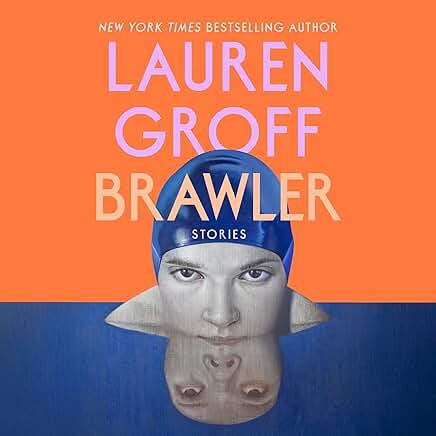
One writer who always inspires is Lauren Groff. I especially admire her short stories, and her latest collection, Brawler, helped me to tune my ear first thing in the morning before I started picking apart my own paragraphs. I’d read probably half of the stories in Brawler already, in The New Yorker, but I was happy to revisit them. The two that stood out to me were the title story, “Brawler,” which I hadn’t encountered before and went to a place I didn’t expect at the end, taking a dive into the spiritual depths, which is something of a Groff specialty. The other story I really liked, which I’d read before, was “Birdie.” It’s a story where characters tell each other stories, which is one of my favorite kinds of narratives—the story within a story. I try to do that when I can but it’s hard to pull off.
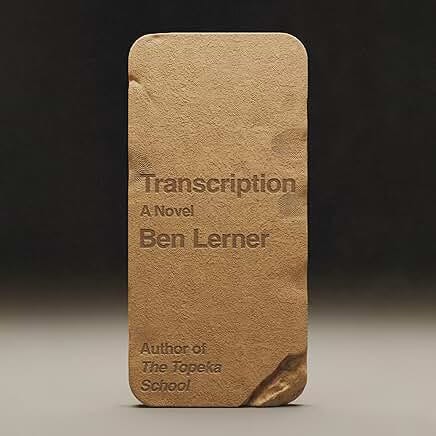
Another writer of my generation who I always read is Ben Lerner. At 130 pages, his new novel, Transcription, feels closer to a novella, though I guess publishers shy away from that descriptor. I read it over the course of one day and when I got to the end, I had the impulse to read the whole book again in order to better understand it. Lerner got his start as a poet and this book felt the most like his poems do. The ending, especially, landed like a poem, where you find yourself stilled and kind of awed, wondering: what just happened?
Transcription is divided into three sections. I won’t spoil what each is, but the premise is that narrator, a middle-aged writer—who I think I can safely say is close in spirit to Lerner himself—breaks his phone a few hours before he’s scheduled to interview his aging mentor. His phone is his only recording device, so he must improvise. What follows is an extended interview/encounter between the narrator and his mentor. Everything that follows is related to this first interview. What I liked about how this book was written, and what makes me want to read it again, is the complexity of the connections between the sections. I noticed some patterning and repeated phrases, but I didn’t catch them all or understand how they related to each other. Reading it was like listening to a piece of classical music, where you are carried along by the melody but upon listening again you notice how certain phrases and rhythms are repeated and repurposed.
I also liked how Lerner wrote about technology. Many contemporary novelists will incorporate cell phones and the internet into narrative, but they tend to focus on the information that technology provides and how it affects characters’ actions. Lerner is more interested in how the constant presence of a recording device and information hub internally affects our habits of mind, inner dialogue, and attention. He shows how pervasive the phone is, how it’s present even when it’s not—even when a phone is dead, unable to record. (As I write this, I feel somehow that ‘phone’ is not the right word, because the little computers we carry with us are so intrusive that a simple noun does not seem strong enough.) I hope I’m not making it seem as if this novel is “about” phones. It’s more that Lerner’s book describes, better than most, how it feels to be alive right now, living among these devices.
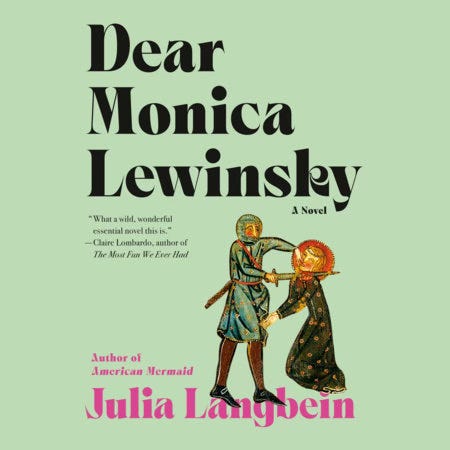
While I admire Lerner and Groff and am always eager to read them, my personal favorite recent read—the one that made me cackle but also hit me hardest, emotionally—was Dear Monica Lewinsky by Julia Langbein. I’ll tell you the plot but whatever you think it’s going to be like after reading my description, you’re probably wrong. Because there’s something kind of bonkers about the writing that defies summary. Its narrator, Jean Dornan, is a 44-year-old former chef stuck in a dead-end job as a legal transcriptionist. She receives an invitation to celebrate the retirement of her former professor, a man she had an affair with when she was 19, in the summer of 1998. The invitation throws her into a tailspin because she has a lot of unresolved feelings about the affair. She thought of it as consensual at the time but looking back on it, from her mid-forties, it hits different.
1998, you may remember, was also the summer of Monica Lewinsky. Those of us who lived through it cannot forget it—perhaps especially, women of my generation, as we were around the same age as Monica. It was a confusing time because any impulse to identify with, or sympathize with Monica was squashed by endless late-night jokes and political cartoons. The feeling was: she was an obviously ridiculous person. Now, looking back, it seems we got the story all wrong.
In Dear Monica Lewinsky, our narrator, Jean, prays to Lewinsky and is transported—in a kind of ecstatic prayer state—back to the summer of 1998, this time with Monica by her side, so they can witness, together, what transpired between Jean and her teacher. Jean has the opportunity look back on her younger self with some compassion, and also be her younger self again. Like I said, it’s hard to describe. I don’t know how Langbein pulled it off, but it’s wonderful and it’s fun because you get to be in France in the 1990s with 19-year-old Jean, looking at medieval churches. There are also many pithily summarized narratives about saints. And food—really good food writing. I just loved this book.
Finally, Some Thoughts on Memoir as a Genre Apropos of Many and Various Hot Takes Flying About
People often read memoirs as if the authors are seeking absolution from the general public. But memoirs are not confessions or avatars. They are narratives constructed by writers to give shape to events, circumstances, situations, passions, intellectual pursuits, relationships—really anything—that they experienced directly. Memoirists can omit facts and events as they wish, and in fact, they will have to leave out a great deal of information to create a coherent narrative. A memoirist should tell the truth, but she is not obliged to be fair, and even if she holds herself to an abstract standard of ‘fairness’ or ‘objectivity,’ a memoir is, by definition, radically subjective. The memoirist does not pretend, as a novelist does, to occupy the consciousness of another person. I’ve always loved the intimate spell that a memoir casts, that feeling of hearing a story directly, from one person. But I never forget that it’s a written story; that is, the author’s impulses are chiefly literary, not personal or interpersonal.
❤️ Link Love ❤️
This article about publishers “updating” kids’ books made me put my head in my hands. [gift link]
Please, seek out Ivy Meerpool’s new documentary about E. Jean Carroll: Ask E. Jean. It’s not on a streaming platform yet, but is showing in some U.S. cities this weekend. The doc had difficulty finding distribution, possibly because people are scared to promote films that criticize President Trump. Read Meerpool’s essay about that here: [gift link.]
The Guardian made a list of the 100 Best Novels.