
Summer Reading Diary
Wishing for a new WPA moment for writers and artists

The books I’ve been most excited about this month are two memoirs that are not coming out until January 2027 . . . so, I will refrain from writing about them at the moment except to say that people were really going through it during Covid. I think we’re going to see a lot of memoirs in the next 5-10 years that help explain what happened to the American psyche in 2020 – 2022. I’m especially interested to hear from the kids who were in school then, though that might take a little longer to unfold.
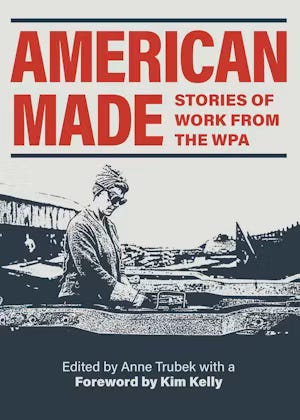
Speaking of the American psyche, I read a fascinating collection of interviews called “American Made: Stories from the WPA”, released by Belt Publishing in June. These interviews, curated by Anne Trubek, founder of Belt Publishing, were originally commissioned by the WPA and conducted by freelance writers—among them, Ralph Ellison. The idea was to create jobs for writers during the Depression and also, to record the lives of regular working people. The anthology includes interviews from a quarryman, newsboy, doctor, butcher, miner, peddler, musician, and many different types of factory workers. They are fascinating transcripts, not only for their historical details, but for the way people talked: the words they used, the syntax, the turns of phrase. As a fiction writer, I found them incredibly inspiring. Here’s a Nebraskan farmer describing what it was like to immigrate to America from Germany as a little boy:
We sailed on the ship Atlantic from Bremer Hafen in the early fall of 1886. We were three weeks on the water and there were 700 people on the ship, and I remember I always used to enjoy to go on the deck and watch the big fish eat scraps of food that were thrown overboard, and sometimes the water was pretty rough. On the way over, the ship stopped someplace in England to take coal. We landed in New York City and stayed there one night and my father took me to see the big buildings. The next day we got on a train and went to Mayville, Wisconsin. When we got there is was awful cold and there was lots of snow. While we were there my father used a horse and buggy to see if we could find a farm that he could buy, but those places that he liked had so many maple and walnut trees on it that it took so much work and time to clear it for farming. So many people there were making their own maple sugar and syrup. We stayed there about six months and came to Omaha, Nebraska . . .
Here’s another one, from a woman working in a meatpacking plant:
I used to have to pack brains in cans. They would be frozen stiff and my nails would lift right up off my fingers handling them. It’s always wet there and very, very cold. I had to wear two and three pairs of woolen stockings, two pairs of underwear, a couple of woolen skirts, and all the sweaters I had, and on top of that I had to wear a white uniform. My own. But I couldn’t stand it there, it was so cold. It’s easy to get pneumonia in a place like that. Then I worked in the sausage department . . .
One more from a Portuguese fisherman on Cape Cod:
We made the Cape. We built it up. We’re the Portuguese pilgrims. Us and the American fisherman. We make Gloucester too. I was up there a couple of years. I fished all over, out of Chatham, out of Gloucester, everywhere. When first come here there wasn’t nothing but sand and a few houses and docks and boats. We used dry the codfish out on the dunes. They’d be pretty near miles of it spread out. The whole place stunk. They was fisherman up and down the Cape. The old whalers went out then. Captain Avila down here, he found a chunk of ambergris once. And fishing off the Grand Banks was a gold mine. You’d get so much you couldn’t load it all. Times you’d be up two, three nights cleaning, up to your knees in it and half frozen. Then the artists they come down. They must have painted a hundred miles of nets and boats and docks. And then the writers heard about it and the summer people. But we started it.
The details in these narratives are so evocative: the little boy, watching scraps of food thrown overboard, and then being whisked from New York to the depths of winter in Wisconsin. That whole paragraph reads to me like the start of a novel. I can see the layers of clothing the woman in the meatpacking district wore, and I can imagine her washing them at home, trying to get the stink out. I loved the interview with the Cape Cod fisherman, especially, because I love the Cape and because he seemed happier in his life than most of the interviewees. He was out on the ocean every day and obviously took pride in the impact his industry had on the region. But there’s some sadness for a modern day reader, too, because the abundance of fish he describes doesn’t exist anymore.
I could have quoted from so many other interviews. There’s one with a newsboy that seems like it had to have been a primary source for the musical “Newsies.” Another conducted by Ralph Ellison feels like it must have influenced Invisible Man. His interviews felt a bit more shaped, in a literary way, than some of the others. It seems writers had free rein to structure their interviews as they wished, though all were required to give some basic contextual information. Some writers produced accounts that feel like transcripts; others, like Ellison’s, sound more like monologues. Many are journalistic, providing descriptions of the surroundings and the subject’s physical appearance.
The whole time I was reading this anthology I could not help thinking how wonderful it would be if the federal government launched a similar program today, sending writers of all genres around the country to talk with people about their day-to-day lives. It would be a shot in the arm to the writing community as we are being told that our work is superfluous in the age of LLMs. In addition to giving writers meaningful work, a WPA-style interview program would likely lead to a lot of interesting reporting and writing. I’m sure journalists would stumble upon interesting leads, poets and playwrights would be catch scraps of dialogue, and novelists would find stories to tell.
As long as I’m in my dream world, I’d love to see a much, much more expansive public funding of the arts with programs for actors, musicians, dancers, painters, artists, theaters, curators, critics, etc. Not as an “investment” in someone’s talent that will pay off later, but as a gift provided with the understanding that art has value even if it is not profitable. We should fund art for the sake of itself, because it connects people to each other, because it is fun, and because artists increase human understanding in the same way that scientists do. And, honestly, you don’t have to pay artists that much! Give them a modest salary and some healthcare and they’re good to go. (Imagine how many artists, theaters, choruses, literary magazines, and concerts you could bankroll with the 37.5 billion dollars that the war in Iran has apparently already cost.)
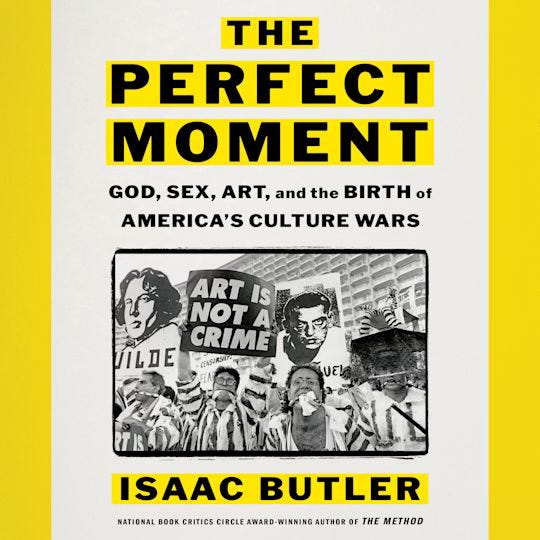
On the subject of arts funding, some of what I wrote above was inspired by listening to Isaac Butler’s new book, The Perfect Moment: God, Sex, Art and the Birth of America’s Culture Wars. This nonfiction book traces the rise and fall of NEA artists grants and how the right successfully villainized specific works of art as unworthy of taxpayer funding in order to advance a conservative agenda to shrink social programs and enrich corporate shareholders. In the process, they also chilled free speech and put forth an idea that if art isn’t going to make money, it should at least be useful, edifying, and inoffensive. I personally bristle at the idea that art must be “good for” something. This, unfortunately, is a sentiment that I occasionally encounter in the literary world with readers and writers championing reading as an aid to self-improvement or as something that can build community or teach empathy. I’m happy for books to do any of those things but a piece of writing can also be odd and cranky and leave you in a weird mood. (Many of my favorite books and movies were ones that, upon first encountering them, I felt confused and even a little irritated.)
Butler’s book hit close to home for me, as Butler and I are almost exactly the same age and grew up in the same region of the country, albeit in very different milieus. He is a D.C. kid who came up in the area’s vibrant local theater scene, working as a child actor, while I lived in the western arm of Maryland, in a community that loved theater and music (especially marching bands) but where a conservative outlook prevailed, especially in cultural matters. I can recall local disgust over some of the artworks that Butler discusses, including Andre Serrano’s “Piss Christ,” and the Robert Mapplethorpe retrospective, “The Perfect Moment,” which gives the book its title. I was surprised, in general, by how familiar I was with the culture wars of the 1990s. I guess I paid more attention to them than I realized—or perhaps my mother did, and I absorbed it through her. She made fine arts quilts and knew people who received funding from the NEA for their work. Among artists, there was always the precarious feeling that artists’ grants would be cut.
My mother often took me to galleries and exhibits in D.C. as well as to local crafts fairs. Artists, in my experience, were not remotely like the demonic destroyers of family life that the religious right made them out to be. Generally speaking, they were more interested in making art than shaping political discourse. When discussing their artwork, craftspeople and visual artists talked mostly about the properties of the materials they used and how they manipulated them to achieve specific effects. From talking to artists (and my mother) I learned that some materials were more expensive than others and required different amounts of space. I realized: 1) that an artist’s work is defined in part, by what materials they can acquire and where they can work; and 2) the meaning of an artwork comes, in part, from the materials themselves and the circumstances that produced them. I admired how artists worked with what they could scrounge up, seeming, at times, to make something from nothing.
Several of the NEA’s most controversial grantees were performance artists who used their bodies as their material, and who wanted to challenge the definitions of art itself. Performance art does not produce work that fits easily into a market economy, which was a problem for the NEA in terms of explaining its value to the public. But the truth is, most art does not fit into the marketplace. The vast majority of artists, musicians, and writers in this country make little or no money from the art they produce and yet still find value in sharing it. Butler argues that proponents of the NEA made a mistake when they tried to justify funding the arts in economic terms. As an example, community theaters could be said to be “good for the local economy” because they bring increased revenue to local restaurants. But theaters should not exist so that people will buy more goods and services. They should exist because people enjoy writing plays, acting in plays, watching plays, and gathering together to talk about the play they just saw. This may be a wild thing to say, but: it’s perfectly okay for public funds to go toward creative projects that don’t make anyone any money.
Butler narrates his book in a conversational tone that makes it easy to follow. It’s very well-researched and includes a lot of interviews that Butler conducted himself with artists and NEA employees. When quoting from his sources, Butler draws on his acting background and changes his voice, sometimes even putting on an accent. At first, I found this a bit silly, but as the book progressed it became useful because he sometimes quotes three or four different sources within a few pages and it’s helpful to know when a quote is beginning and ending and to understand that it’s a new person we’re hearing from.
I’ve gone longer than I intended on these first two books, so I will postpone writing about the novels that have been occupying my time. I’ll be on vacation for the next two weeks, but back in late August with new posts. Until then, if you would like to be like the NEA of yore and support this labor-of-love newsletter, please considering subscribing below.
‹›‹›‹›‹›‹› LINKS ‹›‹›‹›‹›‹›
Maine explained in 40 objects.
Are we living through end of reading? This NPR news story includes a provocative theory that Library of Alexandria was not burned through an act of war but maybe because people just stopped reading as much and let the library fall into disrepair.
How many books is too many? I can tell you, from first hand experience, that it is exceedingly difficult not to collect too many used books while living in NYC. Especially in the Marie Kondo years, the stoops were always teeming with freebies. (gift link)
Apparently writers are attempting a literary style that is personal, bizarre, and idiosyncratic so as not to be mistaken for AI. Which just sounds like good writing to me. I’ve always liked to feel the sense of an individual, with their particular hang-ups and problems, behind the text of a book. And I think many of the “great” novels are like this, with a certain messiness and weirdness that is hard to market or summarize.